Active cell balancing at the cost of passive balancing
Conventional active balancing works, but it is expensive and complex, which is why most packs still burn the difference in resistors. Our patented circuit moves charge to the cells that need it with very few, inexpensive parts, balances several cells at the same time and is simple enough to be highly reliable.
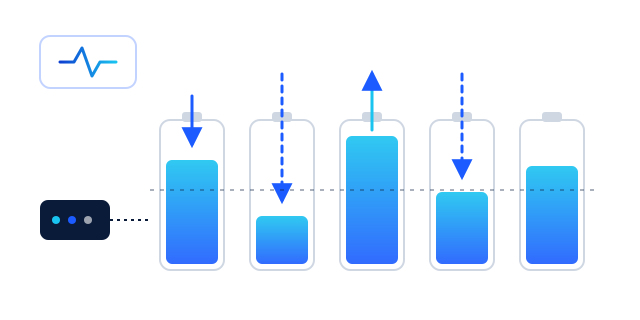
What makes it different
- Low cost
Every cell gets a small, identical module built from a handful of standard components. No multi-winding transformers, no large switch matrices, no expensive gate drivers.
- High efficiency
Charge is moved, not burnt: over 95 % of the energy arrives at the target cell, so there are no balancing resistors and no extra cooling.
- Many cells at once
All channels can work at the same time with about 2 A each, so even large packs are equalised quickly.
- High reliability
Simple switching signals instead of high-frequency control, isolation of every cell and identical modules in every position keep the design robust and easy to test.
The circuit details are protected by patents in Europe, China, Taiwan and other countries. Technical documentation is available to partners under NDA.
Active balancing approaches side by side
Cost is the component cost per cell channel at typical volumes.
| Approach | Cost per channel | Complexity | Balancing speed | Several cells at once | Control |
|---|---|---|---|---|---|
| Bidirectional flyback | ≈ €3.0 | high | high | yes | high-frequency |
| Switch matrix | ≈ €2.0 – 3.0 | high | high | no | high-frequency |
| Bidirectional buck-boost | ≈ €2.5 – 3.5 | medium | low | yes | high-frequency |
| External top-up charging | ≈ €0.6 – 1.2 | low | very low | no | simple |
| Ethast | ≈ €0.75 | low | very high (≈ 2 A) | yes | simple |
What the difference means in operation
| Criterion | Passive | Active, conventional | Ethast |
|---|---|---|---|
| Principle | Burnt in resistors | Moved between cells | Moved, simpler circuit |
| Efficiency | low (< 50 %) | high (> 90 %) | very high (> 95 %) |
| Heat | high, cooling needed | low | very low |
| Circuit complexity | simple | complex | simple |
| Cost per channel | ≈ €0.30 | ≈ €3.00 | ≈ €0.75 |
Benefits for your pack
- More usable capacityThe weakest cell no longer cuts the pack short; charge is moved to where it is needed.
- Longer lifeCells stay within a narrow state-of-charge window, slowing differential ageing.
- Less heat, smaller enclosureOver 95 % efficiency means no balancing resistors and no extra cooling.
- Lower cost than conventional active balancingFew, inexpensive standard components per cell.
- Easy scalingIdentical modules for every cell, modules can be combined for long strings.