Two building blocks for a better battery management system
A battery management system has to do two things well: keep all cells of a pack at the same charge level, and know at any moment how full and how healthy each cell is. We have developed our own solution for both.
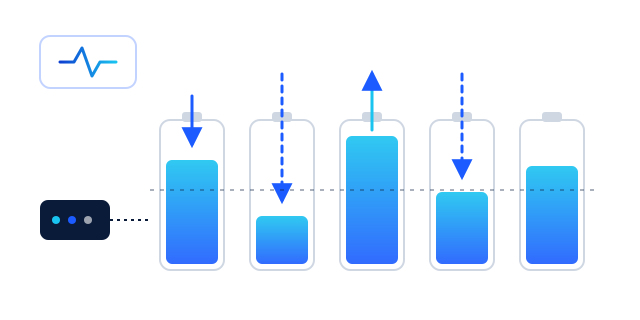
Active cell balancing
Charge is moved to the cells that need it instead of being burnt in resistors. Our patented circuit does this with far fewer parts than conventional active balancing: over 95 % efficiency at component costs close to passive balancing.
- ≈ €0.75 per cell channel
- ≈ 2 A balancing current, several channels at once
- Identical modules for every cell, high reliability
SoC and SoH estimation for aged cells
A 3.5-minute pulse check-up measures the state of health and sets capacity, voltage curve and circuit model. A lightweight filter then tracks the state of charge continuously.
- 87× faster than a full capacity test
- Runs on the low-cost microcontroller already in your BMS
- No cycling history required
Ageing is the problem, information is the answer
The cells of a pack age differently. Capacity and internal resistance drift apart, and the weakest cell limits the usable energy of the whole pack. Passive balancing burns the difference in resistors; active balancing moves it, but has so far been expensive and complex.
For the balancer to work well, the system needs to know the state of charge of every cell, even when the cell is aged or its history is unknown. That is what our estimator delivers: a short check-up instead of a full capacity test, then a lightweight tracker that runs on the microcontroller you already have.
- EU battery passport: state of health becomes mandatory data from 18 February 2027 for EV, light-transport and industrial batteries above 2 kWh
- Second-life sorting, swap stations and fleet operators need fast, low-cost diagnostics
- Both methods were developed on real measurement data and run on standard low-cost microcontrollers
Where the technology is used
Light electric vehicles
E-bikes, scooters and cargo bikes with small, cost-sensitive packs.
Stationary storage
Home and commercial storage with long service life and mixed cell ageing.
Second-life packs
Fast intake grading of cells with unknown history.
Swap stations and fleets
Every returning battery is graded in minutes and tracked in operation.